
Higher education leaders call for overhaul of 'broken' university systemby Emily Jacobs
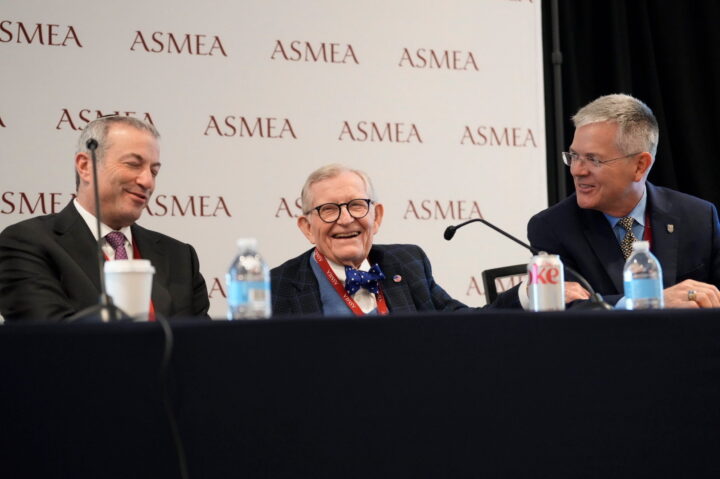
Several higher education leaders raised the alarm on Sunday about the need for an overhaul of the university system, warning that some of its core components, including tenure protection for faculty, had become primary drivers of distrust in universities. The warnings came at the Association for the Study of the Middle East and Africa’s annual conference in Washington on Sunday, during a panel with Rabbi Ari Berman, president of Yeshiva University; Gordon Gee, president emeritus of West Virginia University; and David Ruth, provost of the University of Austin. The session was moderated by Jewish Insider U.S. editor Danielle Cohen-Kanik. “The structure of the university as we know it is broken in so many ways,” Gee, who has led several universities across decades and is seen as a patriarch among higher education leaders, said. “There’s the tyranny of tenure. … Tenure limits the intellectual capacity of people to perform,” “The purpose for tenure was to allow people to have academic freedom inside their classroom. That is protected by the law now. So, what is the purpose of tenure?” he continued. “Is it job security? If it is, that’s not what we need to have. Is it to allow people to be able to bully other people because they’re not doing what they should be doing according to the laws of physics that they have there? I don’t know.” In addition to tenure, Gee identified four areas currently under “tyranny” and in need of reform. “There’s the tyranny of the department. These departments tend to be self-aggrandizing, and people believe that they are the important part of the institution, not that there is a global institution or an organic system,” he said. “The second are colleges, because what colleges do is they put limitations on the ability for people to be able to move across the intellectual life of an institution. The third thing is there’s the tyranny of the gerontocracy, old people running universities — I hate to say that, but I have a right to say that — because so many old people are hidebound to do the way that things were,” Gee, 83, continued. He added that he believes “reform really starts in a fundamental way of restructuring institutions. I would move from the vertical university to the horizontal institution. I would get rid of many aspects of the institution and make it a very simple way for people to connect with each other. Yes, we need to have disciplines. Yes, we need to have knowledge at a deep level, but we don’t need to have it become a limitation. Rather, it should be a growth factor.” Ruth noted that UATX was “trying to do things in a better way.” Ruth continued: “Gordon said, ‘Don’t have departments.’ We don’t have departments. [He said,] ‘Don’t have tenure.’ We don’t have tenure.’” The school was founded in 2021 based on what its architects — including CBS Editor-in-Chief Bari Wiess, venture capitalist Joe Lonsdale and British historian Niall Ferguson — viewed as a failure on the part of legacy institutions. Berman argued that not enough attention was being paid to how leaders looking to improve the higher education system in the U.S. could work together in common cause. “Why don’t we also work on not just who should resign, but who should we be promoting?” Berman said. “Who are the allies that could actually come around and talk to one another and strengthen each other? We need to find those.” “Instead of just going into the problematic universities — and they’re going to have trouble doing that, and with their tenured faculty, there’s always going to be problems — identify the ones that stand for the American values,” he continued. “They should be grouping together, we should be grouping together. That will form a model that will then help spread to other universities.” Asked about what the Democratic sweep in the 2026 midterm elections could mean for higher education, Gee warned that the Democratic Party was likely to push for more regulations on academic institutions. “Having lived through both Republican and Democratic administrations at the national level, I will tell you that the Democrats are much more focused on regulation. They just overregulate the hell out of you. In both the Obama administration and the Biden administration, I hired more lawyers than I did faculty, and I think that that will continue to be a problem,” he said. Gee said he believed that the 2024 election was “more about higher education” than the 2026 vote. “If you put Donald Trump aside, there were vast numbers of people in this country who voted because of the fact that they were tired of the cultural elites and the coastal elites telling them what to say, what to do, what pronouns to use,” Gee said. “I think that that is still very prevalent in the American mind about universities being vestiges of overreach in a number of different ways.” The panelists warned several times about declining trust in higher education, with Gee pointing to the latest Gallup polling that shows public trust in American universities has plummeted in recent years to just 31% approval, down from 95% when he first became a university president in 1980. “We’re actually heading in the wrong direction. The reason that that is important is that for universities to be relevant in today’s world, and for our work to be relevant, we have to have the trust of the American people,” he explained. “If we lose that trust, then we are no longer relevant, and in fact, we become sidebars. That is something that we really cannot tolerate.” |